

Within the spiral, you may find yourself face-to-face with a version of yourself that feels both deeply true and strangely unknown.
As I discussed last month, the spiral of dysregulation is a profound one. It is the center of our trauma and our healing. Meeting dysregulation is an inevitable part of healing and self-actualizing. One of the most common misconceptions is that dysregulation is something that is threatening and, hence, needs to be regulated. Well it may need to be, at times, but dysregulation within the framework of healing is very uncomfortable, but not a threat. The only threat lies in the fact that trauma had once made it impossible to sense into it. Within the context of healing, it must be expressed and felt for a necessary response of completion. Perhaps the most important difference between trauma and healing is that trauma is experienced in the absence of safety, while healing unfolds in its presence. Without the adequate safety, there is actually much unfeeling that has to happen to survive. Conversely, when approaching healing, it becomes safe to express, so safe (when I say safe here, think accessible; because the initial bouts of safety will not feel safe) that we become sensitized to much of everything that had been dissociated from (including the dissociation, itself), causing the vast experience of chronic dysregulation. It feels much more dysfunctional and unstable because we are finally meeting what is deeply true yet profoundly hidden.
This spiral can feel very similar to the prolonged experience of chronic emotional flashbacks, depersonalization, re-experiencing implicit memory, and the presence of silent (acephalgic) migraines. It can also feel like increased awareness of strange dissociative experiences. Sometimes, through trauma, we dissociate by forgetting entirely. We survive through lack of attunement. Healing can feel strange because we begin to feel the dissociation itself.
Yes…dissociation—the lack of feeling is a feeling too.
What all of these experiences share in common is the inherent disorganization that must beget integration. In fact, when we are evolving, further embodying, healing, and self-actualizing, what we are doing is actively finding implicit memory for the first time.
It is through healing, that we are experiencing the trauma for the first time.
Part of experiencing involves moving within the paradox of becoming profoundly embodied in our internal experience while simultaneously knowing very little about it. When enduring trauma, we leave the body; when healing, we enter the body, and the chronicity of implicit memories that we learned to sever ourselves from in the wake of the impact. And by implicit memories I mean, procedural memories, ones that are stored in the body, that inform our state of being and taking up space in the world. It is the memory that you live through rather than the memory that you remember. As safety increases, awareness increases; and, so we become sensitized to experiences that were previously stored outside of conscious awareness and internal experiences that were consistently being molded outside of our conscious awareness. What once remained dissociated begins to emerge. As a result, healing can feel surprisingly unstable, not because we are becoming more broken, but because we are finally coming into contact with what has always been there.
And so the core of this post..how do we interact with what has always been there for the first time?
Well…for one, we must approach this dysregulation with love. Yes…love. Love is the cornerstone of self-connection, and connection is the cornerstone of integration. Love is the cornerstone of co-regulation without the presence of a safe external person. The core process of healing is twofold—the inviting of disorganization and undergoing of integration as a result. And so when we make space for dysregulation, we want to make space for and anticipate these two internal functions. One way to make space for dysregulation, rather than fighting or controlling it, is to begin relating to it as a part of yourself—a way of being, a state, or even an energy. When this energy shows up, it will certainly impact some of your self-energy—the feeling of being tethered, the energy that best reflects you. Imagine that the energy of dysregulation is shadowing you in your day-to-day. Naturally, welcoming this part of yourself will alter your capacity. It learns from you. It can feel like it’s taking from you; but, ultimately it is showing you, and, as such, by showing you, you can begin to increase your capacity for it. The important thing to remember is that this part is shadowing you, not the other way around.
It was born from the Self, not the other way around.
There will always be a semblance of self-energy there, as you are the Being that they are attaching to. If it wasn’t for you, they would not show up—something important to remember in times of great frustration and uncertainty.
The crux of this spiral involves simultaneously creating differentiation from the part while remaining in relationship with it. To recognize that it is a part of us, is to retain self-energy even in the strongest pulls of dysregulation. We want to locate where self-energy lives and how it shows up when in this state of being, even though self-energy may look and feel very different when migrating into and meeting dysregulation. How does self-energy seem as a perceptual experience, a sensation, an energy, and a moment in time even when moving through this spiral? We need that slight point of differentiation to be able to tether into this spiral.
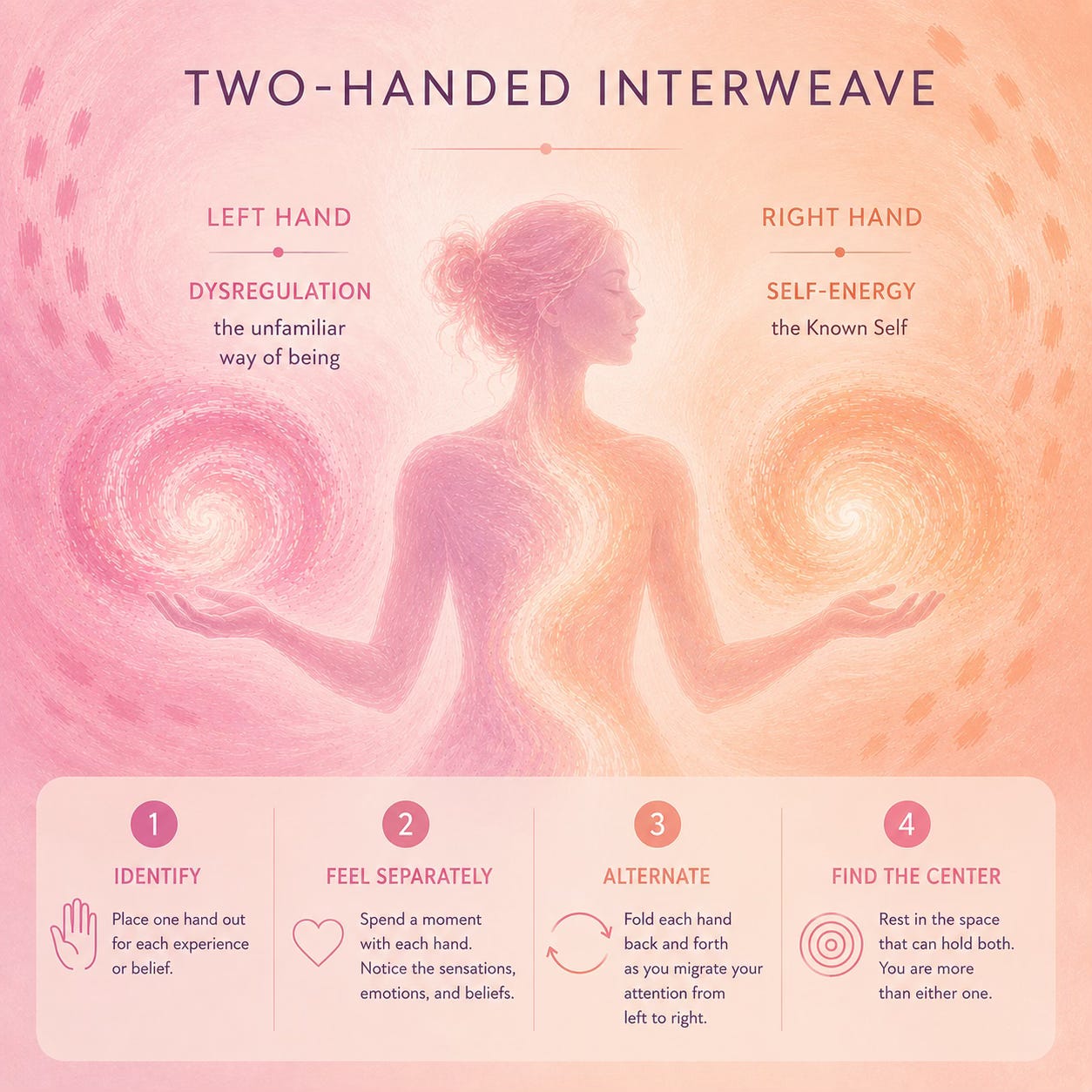
One helpful exercise to incorporate into this spiral is the two-handed interweave. This exercise involves bilateral stimulation (BLS). BLS allows for both hemispheres of the brain to communicate and allows for dual awareness of both states of being (i.e., the left brain—cognition, perception, adaptive memory storage, explicit memory [the memories we can recall visually and chronologically] and the right brain—emotion, meaning of experiences before we can place language to them, the felt sense, and implicit memory). In this context, incorporating BLS would allow for the known Self to make space for and interact with the dysregulated part that is showing up for the first time. BLS is any action/motion that involves both sides of the body and brain (e.g., eye movements, tapping on either side of the body, walking, running, swaying). The two handed interweave involves—
Placing both hands out (in front of you or to the side of you with your arms elongated) and imagine that you are placing your self-energy/your Known Self/the you that remembers who you are in your dominant hand and placing the energy of dysregulation in the other hand. The energy of dysregulation can be different for all of us (the dysregulated part can also better land as, the frightened part, the detached part, the depressed part, the migraine state, the altered state, the activated part, the shut-down part, etc).
Turning your attention toward your dominant hand and noticing how self-energy feels—noticing the quality of the energy, its color, how your sense of being, perception and/or experience may shift/sharpen when sensing into this energy. (Stay here for 60 seconds or as long as is comfortable without forcing it). After, slowly migrate your attention toward your non-dominant hand where you have placed dysregulation. Notice how this energy feels in your hand, only sensing into its edges or the parts of the energy that feel tolerable. If this energy feels too big, noticing how you can contain it by only allowing it to remain in your hand. Imagining that if you put it in your hand, for the purposes of this exercise, it cannot travel anywhere else in your being for the duration of this exercise. This energy can feel like unreality, feeling far away, depersonalization/derealization, mental fatigue, buzzing, feeling perceptually altered despite normal vision, emotional flatness, panic, anxiety, depression, somatic symptoms, brain fog to name a few; stay here for up to 60 seconds at a time). Practice turning your attention toward each hand, keeping each hand faced up and out. Try 3-6 rounds of shifting your awareness back and forth between each open hand.
When you have been able to comfortably attune to both energies and shift your awareness between both energies, begin to fold each hand back, starting with your dysregulated part, the part that feels more present in the moment. As you fold your non-dominant hand back, the dysregulation speaks and as you fold your dominant hand back, imagining that your self-energy/Known Self is responding back to the part. Folding each hand in is an act of BLS and is intended to reflect a conversation between both parts of you. Don’t overthink the conversation. Listen to what the dysregulated part may have to say and notice how it wants to communicate with you. Fold each hand back, as you proceed through an internal dialogue. An initial conversation may look something like this—
Dysregulation
— “I feel horrible and very uncomfortable.”
Known Self
— “I know. I have felt you carrying that.”
Dysregulation
— “I am tired of carrying it. It feels heavy.”
Known Self
— “That sounds exhausting.”
Dysregulation
— “You don’t understand. I used to wake up and just feel myself.”
Known Self
— “I remember.”
Dysregulation
— “Then where have you been?”
Known Self
— “I’ve been here the entire time.”
Dysregulation
— “It hasn’t felt like it. What if something is permanently wrong? Will I feel like myself again?”
Known Self
— “You’re frightened.
Dysregulation
— “Answer me.”
Known Self
— “You are helping me experience things that I haven’t been able to experience before.”
Dysregulation
— “When will it stop?”
Known Self
— “I don’t know. But we will move through it together.”
The conversation may evolve as you become more comfortable welcoming the dysregulation into the present. Moving through this spiral does not boil down to an exercise, but it does boil down to maintaining curiosity and openness toward the energy that feels distinct. When moving through this spiral, there can be a myriad of parts that show up. You can modify this exercise in the way that feels genuine to your experience. You can choose to put any part in your non-dominant hand, any one part that feels distinct from your baseline.
This BLS exercise allows for three experiences to unfold simultaneously—it allows us to get curious about the dysregulation; it allows us to increase our tolerance to dysregulation; and it allows both hemispheres of the brain to communicate through bilateral stimulation, which works toward dual awareness of the mind and the body, helping them to get on the same page and work toward increased connection and integration. In future blogs, I will incorporate more ego state and BLS exercises that involve conversing with parts of us that may not always involve worded and verbal language.
This spiral asks something difficult of us. It asks us to remain present with experiences that feel unknown while trusting that they belong to us. Healing is rarely the neat return to who we once were. More often, it is the gradual remembering of who we have always been beneath adaptation, dissociation, and survival. The unfamiliar energy that emerges is not evidence that we are lost. It is evidence that something long hidden has finally found enough safety to come forward. The initial manifestation of dysregulation is rarely the final form it takes. What first arrives as panic may later reveal grief. What first arrives as numbness may later reveal longing. What first arrives as disorganization may ultimately become integration. In fact, the version of ourselves that is most authentic is ever evolving. The further we move through the spirals of healing, the greater alignment we will find within ourselves, keeping in mind that the Self will always evolve; but that the feeling of Self will always feel familiar.
The goal is not to eradicate dysregulation. The goal is to develop a relationship with it. To learn its language. To understand what it is carrying. Over time, the energy that once felt frightening begins to feel familiar, and what once felt like fragmentation becomes integration. In this way, the spiral is not a departure from the Known/Self, but a return to it. Moving through each spiral is fluid, not linear. Dysregulation does not necessarily disappear as we move through the various spirals of healing. More often, our relationship to it changes. What once felt overwhelming begins to feel familiar. What once felt threatening begins to feel meaningful. Through repeatedly meeting dysregulation with curiosity, compassion, and love we discover that the Known/Self was never absent. It was simply waiting for us to become capable of holding more of our own experience.
Food for thought.
Kindly,
—Sarah