

This spiral can feel like a disintegration of Self.

We typically enter the dysregulation spiral once we can no longer dissociate, once we can no longer mask. At this point, our tolerance for our own protective defenses begins to deteriorate. It can emerge when there has been too much, too fast, for too long—or not enough for too long, meaning our nervous systems can no longer sustain the strategies that once kept us safe. Deterioration may also happen when it is finally safe enough to feel, even if we are still catching up to the felt sense of safety. Usually, one begets the other.
There is a sense of collapse that communicates that there has been a retreat from then and a leap into what is now. This is the start of safety, even if safety requires dropping into the depths of dysregulation. We often only enter this space when there is enough safety to hold us through the discomfort, even if it does not feel safe. It is the recognition of now versus then that allows us to finally drop into this space—where what was held back can begin to surface.
There are a myriad of internal experiences that can be felt within this spiral. What tethers it together is the re-emergence of previously repressed emotions—feelings that are finally surfacing, even if it feels like being ejected from yourself in the process. During this time, the autonomic nervous system often oscillates between two primary states: hyper-arousal and hypo-arousal—commonly experienced as anxiety and depression. When high-functioning anxiety persists for too long, it can intensify into panic, no longer a response to external stressors, but to the internal experience itself, further reinforcing a sense of unsafety within the body. Once this mobilization/activation has been present for far too long, the nervous system will bring us into a state of immobilization. When this sustained activation exceeds the system’s capacity, the nervous system shifts toward immobilization. It can feel like descending a staircase—each step taking you further from the surface that once felt familiar. This transition reflects depletion—an adaptive move into conservation. If this state persists, it can deepen into dissociation. What feels like a loss of feeling may be the beginning of something else—the system changing how it protects, so that healing can eventually become possible. And, hence, the lack of feeling is actually the start of healing.
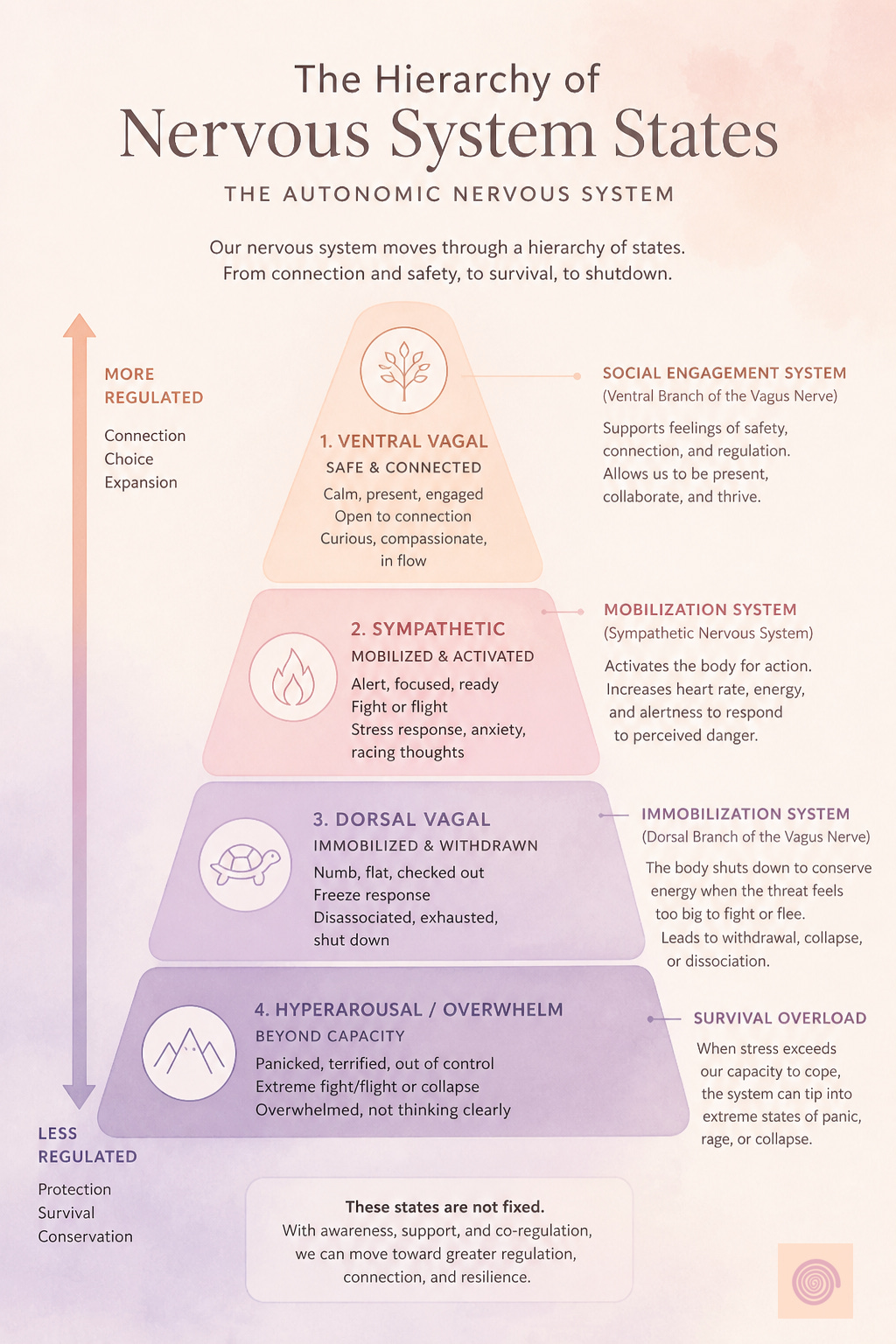
The dysregulation spiral feels like the survival overload state that our nervous system reaches once the dissociation and feeling begin to meet one another. This will feel like hyper-arousal and collapse at the same time. In this collapse, we begin to feel untethered—like our internal processes are not our own, as if we are no longer in control of our nervous systems and physiological responses. We may not recognize the state shifts that our bodies are moving through. Control becomes the least accessible resource within this spiral. Do not attempt to control this experience. It is through curiosity that regulation begins to emerge and movement into the next spiral can begin.
Tether yourself in the idea that you may feel strange. Unlike yourself.
You may experience heaviness, brain fog, feeling mentally sick, flu-like symptoms, hormonal shifts, difficulty swallowing, shaking, trembling eyelids and twitching eyes, fatigue, panic attacks, depersonalization (i.e., altered sense of Self), derealization (i.e., altered sense of reality), perceptual differences, distorted time, thought disruptions, diminished toleration for day-to-day experiences, body dysmorphia, intolerance for existence, depleted energy levels, migraines, insomnia, and most strangely even…you may struggle to find words for what is happening, as if the experience itself resists articulation. It may feel like an alteration. Not an identity alteration. But an alteration of how you experience yourself (not to be mistaken with structural dissociation). In these moments, gently anchoring into your sense of identity can become a resource—a way of orienting back toward something more stable as your system moves through the spiral.
At certain points in the spiral, it doesn’t just feel like control is fading—it can feel like you are fading. The body distances you from the intensity, while simultaneously plunging you into it, softening the edges of reality, of self, of sensation.

Well, how do we access stability and continue to function from within this state?
Curiosity is the first and most accessible resource in a state of dysregulation. It allows safety to emerge in the way that our systems can tolerate. Until what has been repressed begins to metabolize within, safety itself may feel like dysregulation. Self-energy doesn’t vanish in dysregulation—it becomes quieter, smaller, and harder to recognize. Noticing it in small doses allows us to begin resourcing it over time. In regulation, self-energy leads. In dysregulation, self-energy interrupts. What we aim to eventually find in moving throughout the spirals is living from that place of self-energy. As we move through these raw spirals, we learn to anchor into the brief interruptions of self-energy that emerge within them.
What is self-energy?
You may have heard this concept utilized within the Internal Family Systems framework. From an IFS lens, self-energy refers to the inherent, stable, continuous, autonomous, calm, and spacious presence within us that is separate from our parts and can be resourced to support us within the spiral of dysregulation. From an ego state therapeutic framework, the focus is less on a singular core and more on the system’s capacity for awareness. In this lens, Self can be understood as the integrative, observing capacity of the personality—the ability to hold awareness of multiple ego states without being fully taken over by any one of them. In contrast, IFS treats Self (-energy) as a real, ever-present core with inherent qualities. The ego state framework treats Self as a function of awareness and integration within a system of states that develops resources and qualities through experiencing. I integrate these two models into my work and have come to the conclusion that self-energy is a felt-expression that can be further resourced by the Self, which develops over time. The Self becomes more stable and continuous, the more that we can access our internal resources, self-energy being one of those key resources. Some of the most important internal resources within the dysregulation spiral are, remaining curious toward the dysregulation, the ability to remain with the experience, and the practice of presence. These begin to create a point of differentiation, an alternate state to inhabit once the dysregulation settles—an internal space that allows us to relate to the dysregulation, rather than to be entirely consumed by it. Over time, this space becomes an alternate state we can return to—one that forms the foundation for integrating the spirals that follow.
In moving through dysregulation, we want to hold space for the possibility that such discomfort is the emergence of repressed emotions and parts of ourselves that disrupt and interrupt the process of our sense of continuity. The aim of this spiral is to invite curiosity as to which parts of us are showing up, and to begin gently separating from them so they can be explored with greater awareness and stability. However, before we can move into further regulation by entering the next spiral of healing, we must hold dysregulation and remain in the experience. It is only through staying with it that we begin to access greater self-energy. In my next blog, I will share practices to support this process—ways to hold dysregulation while beginning to build an alternate state that can exist alongside it.
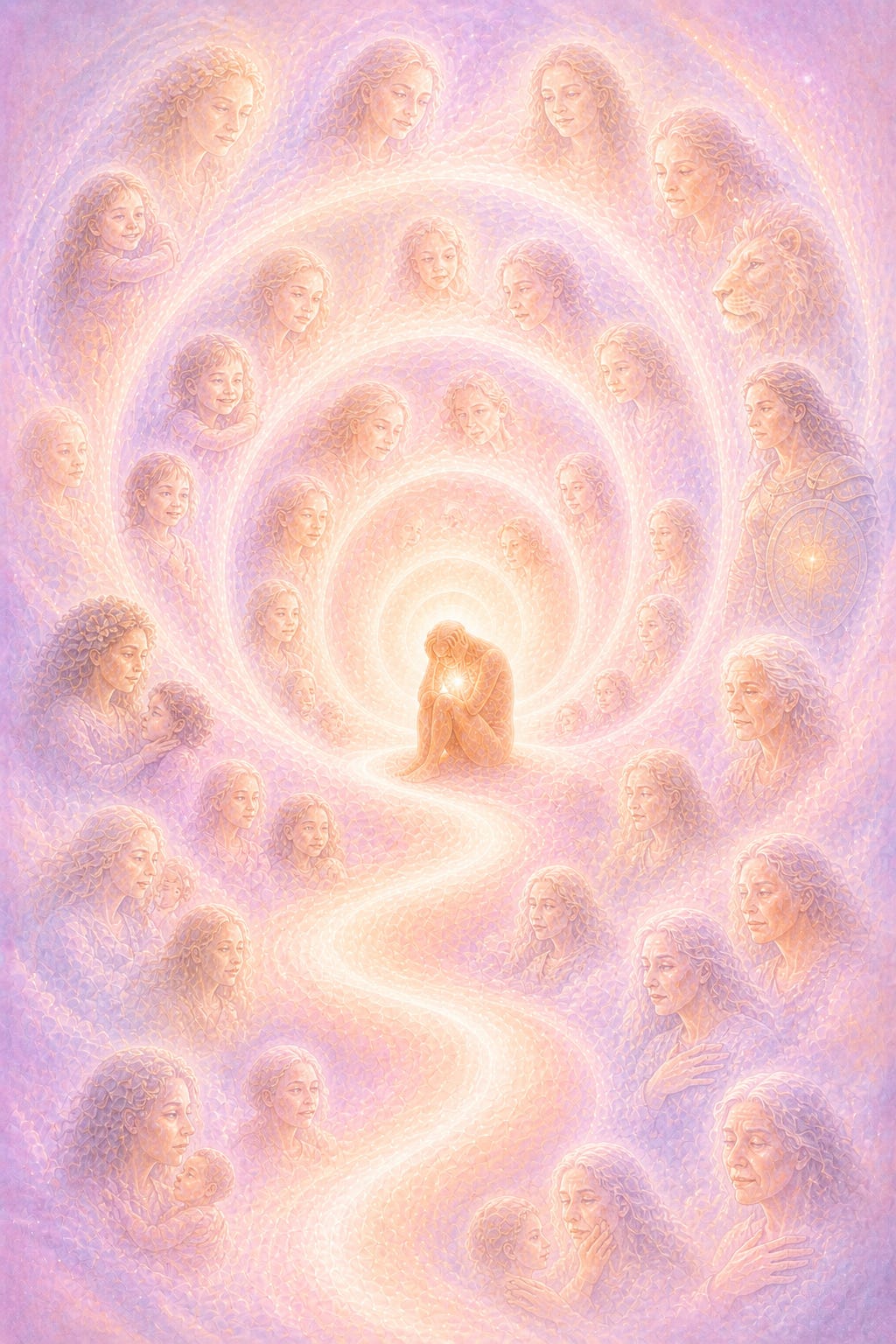
What can feel like a loss of control within this spiral is not the loss of Self, but a shift in access to it. Beneath the intensity, beneath the confusion, something within you remains—steady, observing, and capable of returning. The spiral is not a departure from yourself, but a movement deeper into the parts of you that have yet to be felt, understood, and integrated. And in learning to stay—to remain present within what feels unfamiliar—you begin to build a different kind of stability: one that is not dependent on control, but on your capacity to be with what arises.
Food for thought…
Kindly,
—Sarah
What a masterpiece!